

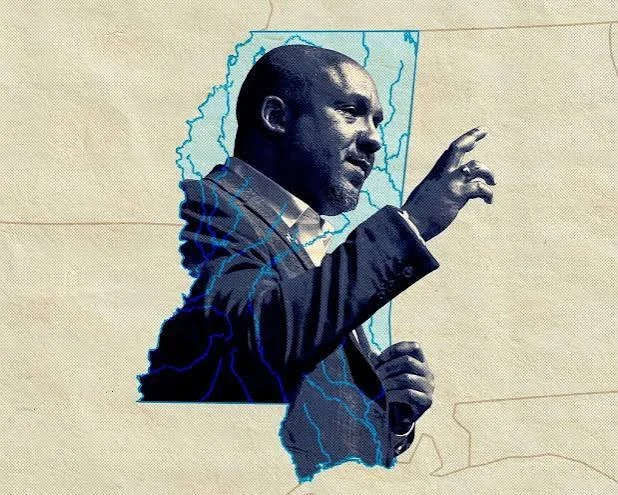
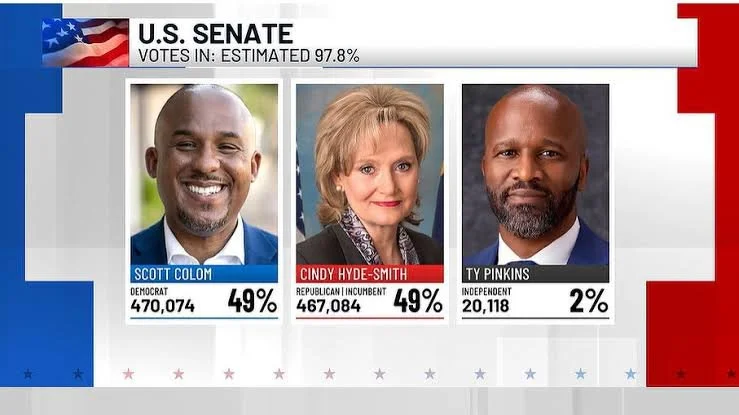
In one of the most closely watched and consequential results of the 2026 midterms, Democrat Scott Colom defeated incumbent Republican Sen. Cindy Hyde-Smith in Mississippi’s U.S. Senate race. The Associated Press called the contest on November 11 after days of counting absentee and provisional ballots, with Colom leading by roughly 4,600 votes at the time of the call—about 49.2 percent to 48.7 percent. Independent candidate Ty Pinkins received just over 2 percent. Hyde-Smith later conceded. The outcome marks the first time a Democrat has won a Mississippi Senate seat since 1982 and the first time the state has elected a Black U.S. senator since the Reconstruction era.
Colom, 43, is a Columbus native and longtime district attorney for Mississippi’s 16th Judicial District in the northeastern part of the state. Elected in 2015, he became the first Black district attorney in a majority-white district in state history after defeating a longtime incumbent. A skilled prosecutor with a strong trial record, he built a reputation focused on public safety while also supporting programs for first-time offenders and victim services. In 2023, President Biden nominated him for a federal district judgeship, but Hyde-Smith withheld her blue slip and blocked the nomination. Colom later chose to challenge her for the Senate seat.
The victory carries clear historical weight. Mississippi’s previous Black senators—Hiram Revels and Blanche K. Bruce—were chosen by the state legislature during Reconstruction and left office by 1881. Colom is the first Black Mississippian elected to the Senate by popular vote. In his victory speech at historically Black Tougaloo College, he acknowledged that lineage, naming Revels along with civil rights figures Fannie Lou Hamer and Medgar Evers. He framed the win as a collective effort rather than a personal one, telling supporters, “It’s not something that I did, y’all. It’s something that we did.”
Colom’s campaign emphasized a Mississippi-first message centered on household costs, rural hospitals, and practical governance. National Democratic support arrived relatively late, but his local organizing and viral advertising—particularly spots highlighting economic concerns—helped close the gap in a state Donald Trump carried by a wide margin in 2024. The race remained tight through Election Day and the subsequent counting of affidavit ballots, underscoring both the competitiveness and the narrowness of the result.
For Mississippi, the shift is significant. The state has long been a Republican stronghold in federal races. Colom’s win ends that streak for this seat, expands the Democratic majority in the Senate, and places a prosecutor from northeast Mississippi in the upper chamber. He has indicated interest in the Appropriations and Agriculture committees, both of which carry direct relevance to the state’s economy, infrastructure, and rural communities. His experience as a district attorney in the Golden Triangle area also gives him familiarity with issues facing many of the same counties that make up parts of the 1st Congressional District.
The result does not erase the state’s broader political patterns, but it does demonstrate that a focused, locally grounded campaign can produce an upset even in deep-red territory. As Colom prepares to take office in January, attention will turn to how he balances the expectations of a historic coalition with the practical demands of representing an entire state. For voters in North Mississippi, the election of a former local prosecutor to the U.S. Senate is both a milestone and a reminder that statewide races can still be decided by a few thousand votes.